Type something to search...

All Articles

Insights
blog-thumb
By Peter Lin/ On 23 Mar, 2026

A Patent in Hand Does Not Mean a China Market Exists

One of the most common assumptions I see from inventors is this: "I have a patent, so there should be a licensing opportunity in China." I understand why people think that way. A patent feels like proof. It is formal. It is expensive. It reflects effort, legal work, and technical substance. But in commercial reality, especially when dealing with China-facing licensing or manufacturing discussions, a patent is only one part of the picture. It is not the market. It is not demand. And it is not, by itself, a reason for a Chinese company to engage. What inventors are actually asking me I have received messages like these:"I wanted to ask whether any manufacturers, industrial groups, or trusted contacts in China come to mind for this type of opportunity."And:"I am interested in a potential licensing or royalty-based partnership..."And in another case, a client wanted help positioning patented helmet and wearable technologies to Chinese companies, while also asking what proof-of-concept examples could make the pitch credible in China. These are not unreasonable questions. But they often begin one step too late. The hidden assumption is that patent ownership has already solved the biggest uncertainty. It has not. What a Chinese company is usually evaluating When a manufacturer, brand owner, or business development team in China looks at a foreign invention, they are usually not asking first, "Is there a patent?" They are asking:Is there a market? Is there a product category I understand? Is there evidence that users care? Can this be produced, tested, sold, or integrated into an existing business line? Why should we spend time on this now?A patent may support the discussion. But it rarely creates the discussion. Why this gap matters so much A lot of inventors come from a legal or technical mindset. They believe novelty should carry the opportunity. But Chinese counterparties, especially on the commercial side, usually respond to a different logic:practical use production feasibility category fit cost logic sales potential proof from the marketIf those elements are missing, even a technically interesting patent may receive little attention. Three practical examples of the gap 1. The broad humanitarian invention A project may sound meaningful and ambitious, but if the target market, product channel, and commercial buyer are unclear, China outreach becomes abstract. You are not presenting a deal. You are presenting a possibility. 2. The early-stage consumer product concept A founder may have a patent-backed idea for a mount, wearable, or accessory. But if there is no prototype, no customer evidence, and no clear target company profile, the project remains too early for serious China licensing conversations. 3. The technically impressive but commercially unproven portfolio Even where patents exist across multiple filings, the real question remains the same: what concrete product path proves that the technology already maps to something buyers want? Without that bridge, the IP may be impressive, but the market signal stays weak. What inventors should ask instead Instead of starting with "I have a patent, who in China should I talk to?" the better questions are:What specific commercial problem does this solve? Which type of Chinese company would understand it fastest? What evidence makes this more than a technical claim? Is this closer to licensing, contract manufacturing, joint development, or market testing? What would a skeptical buyer need to see before taking a meeting seriously?Those questions are much less romantic. But they are much more useful. Patent value still matters — just not by itself None of this means patents are unimportant. On the contrary, patents may be critical for:defining ownership protecting core features supporting negotiation leverage preventing careless disclosure making future licensing more credibleBut they work best when paired with something else: market proof, product readiness, or a strong commercial narrative. My practical conclusion When foreign inventors think about China, they should stop treating patent ownership as the finish line. It is better understood as part of the foundation. A patent can support a real opportunity. It does not automatically create one. That distinction matters because it changes what should happen next. Sometimes the next step is China filing. Sometimes it is manufacturing preparation. Sometimes it is market validation. Sometimes it is simply admitting that the project is not ready yet. That is not bad news. It is just honest news. And in cross-border business, honest sequencing saves time.

China IP Guides
blog-thumb
By Peter Lin/ On 23 Mar, 2026

We Filed in China — Can We Still Protect the Invention in Hong Kong? A Practical Guide for PCT and China Patent Applicants

A client recently wrote to me with a question that felt very familiar:"We already filed into China through PCT. Do we still have any option to file in Hong Kong? I was told this might be done on the back of the Chinese patent, but I also saw something online about a 6-month deadline after publication. Does that apply to our case?"This is one of those questions that sounds simple at first, but in practice it often determines whether a Hong Kong patent strategy is still alive or already lost. The short answer is: yes, Hong Kong may still be available after a China filing. But the route is separate, the timing is separate, and applicants often watch the wrong deadline. Hong Kong has its own patent system. A Mainland China patent does not automatically extend to Hong Kong, and Hong Kong protection must be handled on its own terms. Hong Kong currently offers standard patents and short-term patents; standard patents can be obtained either by the original grant route, known as standard patent (O), or by the re-registration route, known as standard patent (R). For clients who already filed through PCT and entered the China national phase, the best Hong Kong route is usually standard patent (R) based on CNIPA. Hong Kong expressly allows a standard patent (R) to be based on a patent granted by the China National Intellectual Property Administration, and the Hong Kong process for standard patent (R) is built as a two-stage filing system: first a request to record on Form P4, then later a request for registration and grant on Form P5. That is what many clients mean when they say, "Can we do Hong Kong on the back of the Chinese patent?" In substance, the answer is often yes. But the more precise answer is this: you may be able to use the China route as the designated patent route for Hong Kong, provided the Hong Kong time limits have not already expired. Why Standard Patent (R) Is Usually the Best Route After China For a China-linked case, standard patent (R) is usually the most natural route because it fits the filing structure the applicant has already chosen. Hong Kong's patent framework makes the distinction very clear: a standard patent (R) is based on an earlier corresponding patent application filed with a designated patent office, and CNIPA is one of those designated offices. A standard patent (R) application is subject mainly to formality examination, while a standard patent (O) is a direct Hong Kong filing subject to both formality and substantive examination. That difference matters in practice. If the invention is already being prosecuted in China, standard patent (R) often gives the cleaner route into Hong Kong. It follows the China track instead of opening a separate substantive examination path in Hong Kong. By contrast, standard patent (O) is a direct Hong Kong route and is generally more suitable when the applicant wants an independent Hong Kong filing track or cannot use the re-registration route. Hong Kong's own materials say standard patent (O) can be filed directly in Hong Kong and is subject to substantive examination, while standard patent (R) depends on the grant of the corresponding patent by the designated office. So for a client who has already gone PCT → China national phase, my first instinct is usually not to ask, "Should we file a fresh Hong Kong case?" My first question is: "Is the standard patent (R) window still open?" The Mistake Many Applicants Make: They Focus on the Wrong Date This is where real matters often go wrong. Some applicants think the Hong Kong deadline runs from the PCT international publication date. Others think it runs from the date they filed the Chinese national phase documents. Others assume they can wait until the CNIPA patent is granted and then decide later. For a PCT-based standard patent (R) route through CNIPA, Hong Kong's rules are more specific. The first-stage filing in Hong Kong must be made within six months after the relevant CNIPA event showing that the international application has entered the national phase in China. The exact trigger depends on the language of the international publication. If the international application was published by WIPO in a language other than Chinese, Hong Kong looks to the publication by CNIPA in its Patent Gazette of the relevant bibliographical data showing national phase entry. If the international application was published in Chinese, Hong Kong looks to the official notification by CNIPA showing that the application has entered the national phase in China. This point is extremely important. It means that the key Hong Kong deadline is often not the original PCT publication date, and not simply the day you filed into China, but the specific CNIPA publication or notification event recognized by the Hong Kong rules. In other words, for many cases the real question is not "Did we enter China?" but "What is the exact CNIPA trigger date for the Hong Kong six-month clock?" The Two-Stage Hong Kong Process After a China Filing If the timing is still open, the Hong Kong standard patent (R) route usually works in two clear stages. Stage 1: Request to Record The first stage is the request to record, filed on Form P4. For a PCT-based case entering China, Hong Kong requires the applicant to file this request within six months after the relevant CNIPA publication or notification event. Once the filing is accepted and formalities are in order, Hong Kong publishes the request to record in the Hong Kong Intellectual Property Journal. This is the stage many foreign applicants do not realize exists. They assume Hong Kong only becomes relevant after the China patent is granted. But by that time, the first Hong Kong deadline may already be gone. Hong Kong's FAQ also highlights this first-stage deadline as one of the non-extendible time limits for standard patent (R) matters. Stage 2: Request for Registration and Grant The second stage is the request for registration and grant, filed on Form P5. Hong Kong requires this to be filed within six months after the later of:the publication of the request to record in Hong Kong; or the grant of the designated patent by the designated patent office. For a China-based route, that designated office is CNIPA.Again, this deadline matters. Hong Kong's FAQ lists the second-stage filing deadline as another non-extendible time limit. So even after the first-stage filing is safely on record, the matter still needs to be docketed carefully through the China grant stage and the later Hong Kong filing stage. What If the China Case Takes a Long Time? That is a practical issue, because Chinese prosecution can of course take time. Hong Kong addresses this by allowing the applicant, in certain circumstances, to maintain the standard patent (R) application if the applicant cannot yet proceed to the second stage. The Hong Kong PCT-route guidance explains that if the case cannot proceed to the second stage, the applicant may wish to maintain the application before the expiry of the fifth or any succeeding year from the relevant anniversary of the designated patent application filing date following publication of the request to record. So the real docket is often not just:China grant → Hong Kong grantIt is more often:PCT enters China → CNIPA trigger event → Hong Kong P4 → wait → maintain if necessary → CNIPA grant → Hong Kong P5That is the structure clients should understand from the beginning. What Protection Term Do You Get? A granted standard patent (R) in Hong Kong can last for a maximum of 20 years from the filing date of the designated patent application, subject to annual renewal. The first renewal fee is due on the fourth anniversary of the filing date of the designated patent application following the grant of the Hong Kong standard patent (R), and renewals then continue on each anniversary date until the maximum term expires. Hong Kong also has a short-term patent route with a maximum protection term of 8 years, but for most international applicants looking at a serious China-plus-Hong Kong patent strategy, the more relevant comparison is between standard patent (R) and standard patent (O). When Might Standard Patent (O) Still Matter? Although standard patent (R) is usually the first route to consider after a China filing, standard patent (O) can still become relevant in some cases. The most obvious example is when the applicant has missed the six-month timing for the first-stage standard patent (R) filing. Another is when the applicant wants a direct Hong Kong filing rather than relying on the China grant track. Hong Kong's original grant route can be filed directly in Hong Kong, and in general there is no time limit for filing a standard patent (O), although if priority from a first application is claimed, the Hong Kong filing should generally be made within 12 months of the first application. Hong Kong also requires substantive examination for standard patent (O), which makes it a different strategic route from standard patent (R). So the practical order of analysis is usually this:First, check whether standard patent (R) is still available. If it is, that is often the best route. If it is not, then ask whether standard patent (O) still makes commercial and procedural sense.The Three Questions I Would Check First for Any Real Client Matter When a client asks whether Hong Kong is still possible after a China filing, I usually want three dates or facts immediately. First: What language was the PCT application published in? That determines whether the Hong Kong six-month clock is tied to a CNIPA Patent Gazette publication or a CNIPA official notification. Second: What is the exact CNIPA publication or notification date showing entry into the China national phase? Without that, you cannot safely calculate the Hong Kong first-stage filing deadline. Third: Has the CNIPA patent already been granted? If yes, you then compare that grant date with the Hong Kong publication date of the request to record, because the later of those two dates governs the second-stage filing deadline. Those three points usually tell you very quickly whether the Hong Kong route is still open, and if so, what needs to happen next. Final Takeaway If you already filed a patent in China, or entered China through PCT national phase, Hong Kong may still be available — and in many cases the best route is standard patent (R) based on CNIPA. But Hong Kong is not an automatic extension of Mainland China. It is a separate patent system with a separate filing structure and strict deadlines. The most common mistake is waiting too long because everyone is looking at the China grant and not at the earlier Hong Kong six-month trigger tied to the China national phase entry event. So if a client asks, "We already filed in China — can we still protect the invention in Hong Kong?" the best answer is not just "yes" or "no." The real answer is:"Possibly yes — but we need to check the China route, identify the exact CNIPA trigger date, and make sure the Hong Kong standard patent (R) window is still open."Need help reviewing whether your Hong Kong filing window is still open? We help international applicants assess China filings, PCT national phase entries, and follow-on Hong Kong patent options, including deadline checks and filing strategy. Get in touch →Frequently Asked Questions Does a China patent automatically cover Hong Kong? No. Hong Kong has its own patent system. A Mainland China patent does not automatically extend to Hong Kong. Hong Kong protection must be applied for separately under the Hong Kong system. What is usually the best Hong Kong route after a PCT application enters China? Usually the first route to evaluate is standard patent (R) based on CNIPA, because Hong Kong recognizes CNIPA as a designated patent office for the re-registration route. When does the first Hong Kong 6-month deadline start? For a PCT case entering China, the clock runs from the relevant CNIPA publication or notification event showing national phase entry, and the exact trigger depends on whether the PCT publication was in Chinese or another language. Do I need to wait for the China patent to be granted before filing in Hong Kong? No. In the standard patent (R) route, the first Hong Kong step is the request to record; that usually needs to be filed much earlier, before the China grant stage is complete. What if the standard patent (R) timing has already been missed? Then it may still be worth evaluating whether a direct standard patent (O) filing in Hong Kong is available and commercially justified. That route is separate and subject to substantive examination.

Insights
blog-thumb
By Peter Lin/ On 23 Mar, 2026

Not Every Invention Is Ready for China Licensing

Over the past year, I have noticed a pattern that is easy to misunderstand. Some inventors and patent owners contact me because they see China not only as a filing jurisdiction, but also as a place where their invention might be manufactured, licensed, or commercialized. On the surface, that sounds like an exciting opportunity. But in practice, many of these projects are not actually ready for China licensing. The problem is not a lack of creativity. The problem is readiness. One inventor wrote to me:"I am currently trying to identify the right industrial or manufacturing partners for two of my inventions... My goal is to find companies that could be relevant for production and, where there is alignment, potentially discuss licensing as well."Another wrote:"I am interested in a potential licensing or royalty-based partnership... Who would be the best point of contact to share a non-confidential executive summary?"And another asked for help finding companies interested in producing and marketing innovative toys, while already hoping for a commercial path. These are sincere requests. The people behind them are often serious, intelligent, and highly motivated. But motivation alone does not create a licensable project. The real gap is usually not legal When foreign inventors first think about China, they often assume the next step is to "find the right company." In reality, the harder question usually comes first: Why would a Chinese company care right now? That question forces a much more practical review. Does the invention already have a working prototype? Is there a clear user problem? Is there evidence of demand? Is the product category something Chinese manufacturers or brand owners can evaluate quickly? Is the IP position clear enough to support early discussions? Many projects fail at this stage, not because the idea is bad, but because the commercial story is still too thin. A patent is not the same thing as a market-ready opportunity This is one of the biggest misunderstandings I see. A patent application, or even a granted patent, may define technical novelty. But that does not automatically answer the questions a potential China partner will ask:Who will buy this? Why now? What category does this fit into? Is this a manufacturing project, a licensing project, or a distribution project? What proof exists beyond the inventor's own enthusiasm?If those answers are missing, partner outreach becomes weak and inefficient. China licensing is not random outreach A lot of inventors imagine China licensing as a contact problem: if they can just find the right factory, brand owner, or distributor, the opportunity will unlock. That is rarely how it works. In most cases, before any serious outreach begins, a project needs at least four things: 1. A clear non-confidential story A Chinese company cannot evaluate a project if the invention can only be explained through vague claims or confidential technical detail. There needs to be a simple, commercial explanation of what the product does and why it matters. 2. Evidence of product readiness Drawings are not the same as a prototype. A concept video is not the same as product validation. The closer a project is to something tangible, the easier it is for a Chinese counterpart to take it seriously. 3. A realistic China fit Some inventions align well with China's supply chain strengths. Others do not. Some belong in toys, wearables, sports gear, or consumer accessories. Others are too early, too niche, or too detached from existing buying logic. 4. A commercial path that makes sense Not every project should start with licensing. Some should start with manufacturing. Some need market testing first. Some need better packaging. And some simply need more time. What I have learned from these inbound requests The inbound interest is real. But the business lesson is also real: most invention-led inquiries are still too early to justify deep partner-search work. That matters, because early-stage invention projects can consume a huge amount of time. Reviewing technical material, understanding the product, imagining the China fit, and thinking through possible counterparties is not light work. If the underlying project is still only an idea with no budget, no sample, and no evidence of demand, the effort is usually not commercially justified. My practical view I do think China can be a meaningful market, manufacturing base, or commercialization route for some foreign inventors. But I no longer think the starting point should be "Let us find you a China licensee." The better starting point is:Is the project commercially ready enough? Is there real China-market logic? Is the invention understandable to the people who would have to evaluate it? Is this actually a licensing opportunity, or is it something else?That is the real first filter. Final thought If you are an inventor or patent owner thinking about China, here is the most important thing to understand: China licensing is not a shortcut for an unvalidated invention. Before you look for a partner, you need to know whether your project is ready to be taken seriously. That one step can save months of wasted time.

China IP Guides
blog-thumb
By Peter Lin/ On 20 Mar, 2026

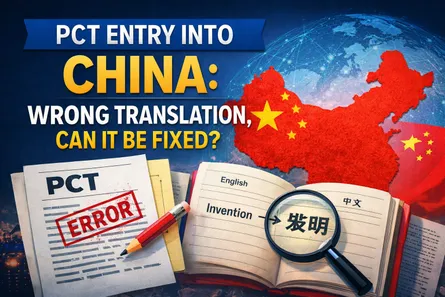
PCT Translation Errors in China: What Foreign Applicants Can Correct, and When

Most foreign applicants submit a PCT translation into Chinese and move on. The translation is outsourced, filed under deadline pressure, and rarely reviewed against the original international application text. In many cases it is fine. But in a meaningful number of cases it is not — and when a translation error in China patent prosecution affects claim scope, the consequences can be permanent. This guide explains what correction is actually available, when it must happen, what makes a change qualify as a genuine translation correction versus an amendment, and how the situation differs depending on how you filed in China in the first place. Why This Issue Matters More Than Most Foreign Applicants Expect Translation in patent work is not a purely linguistic task. It makes legal commitments. A Chinese translation of a PCT application becomes the operative text for prosecution in China — and eventually for enforcement. If the translation unduly narrowed a claim because a technical term was rendered too specifically, or if a feature was added that was not in the original, the Chinese patent that results will not accurately reflect what the applicant actually invented. The commercial stakes are real. An overly narrow claim in China may fail to catch a competitor whose product would clearly have fallen within the scope of the original English claims. A translation that introduced a feature not in the original could expose the patent to an invalidity challenge after grant. Neither outcome is easy to manage, and neither is cheap to fix if it is fixable at all. What foreign applicants often miss is that unlike some jurisdictions where post-grant correction is relatively accessible, China's system is comparatively unforgiving once a patent is granted. The windows to act exist — but they close, and they do not reopen. First, Separate Two Very Different Situations: PCT Entry vs Paris Filing The most important distinction to establish before anything else is this: how did you file in China? If you filed an international application under the PCT and later entered China national phase using a Chinese translation of that international application, you are in a different legal situation from someone who filed a Paris Convention direct application in Chinese from the start. For PCT national phase entries, Chinese law recognises that the Chinese translation is not the original — the international application filed with the receiving office is. This creates space for a translation correction mechanism, because there is a defined reference text against which the Chinese translation can be checked. The rules governing PCT entry into China — filing timelines, language requirements, and the translation submission process — are described in more detail in the guide on 12 vs. 30 months and the critical windows for China patent protection. For Paris Convention direct filings in Chinese, the Chinese text you filed is the original. There is no foreign-language source to correct against. General amendment rules apply, and translation correction as a concept does not exist. These two routes operate under different rules and require different approaches to error management. Conflating them is one of the more consequential mistakes in managing a China patent portfolio. What China Usually Allows for PCT Translation Corrections China's Patent Law Implementing Regulations provide that where an international application was filed in a foreign language and the Chinese translation deviates from the original international application, the applicant may request that CNIPA amend the Chinese text to conform to the original. The governing standard in practice: the correction must be based on the text of the original international application as filed at the PCT receiving office — the International Bureau's record of the application as it existed on the international filing date. Later amendments made during the international phase, whether through Article 19 (claims amendments) or Article 34 (examination amendments), are not automatically the baseline unless those amended texts were formally designated for entry into China. The purpose of this mechanism is narrow. It is designed to restore accuracy — to bring the Chinese text into alignment with what the original actually said. It is not a vehicle for improving claim coverage, responding to prior art identified during prosecution, or adding technical content that was not in the original disclosure. The Two Time Windows That Matter In practice, there are two main moments when a translation correction in China is realistically pursued. Window one: voluntary correction before CNIPA raises a concern. A translation correction request can be filed at any point before the patent is granted. In practice, the earlier the better — ideally before or at the start of substantive examination, before the examiner has relied on the translated text to form any view on the claims or the disclosure. Some applicants with significant China patent programs now conduct a brief translation review of claim language shortly after national phase entry, specifically to catch material errors at this early stage. The cost of doing so is a fraction of the cost of managing the consequences later. Window two: in response to an Office Action. CNIPA examiners do occasionally identify apparent inconsistencies between the Chinese claim language and what the description suggests the invention actually is. Where the underlying reason is a translation error, this is often the first moment a foreign applicant becomes aware of the problem. The response period to the Office Action then becomes the operative correction window. Missing it, or filing a response that does not properly address the translation issue, can produce a permanent narrowing. What there is not, in most cases, is a meaningful correction window after the patent has been granted. Post-grant correction in China is procedurally difficult and not generally available as a practical remedy for scope problems that trace to translation errors. What Usually Counts as a Real Translation Error Not every disappointing outcome in a Chinese patent claim reflects a translation error. The concept has a defined meaning. Translation errors that typically qualify for correction include: Linguistic divergence from the original — where a technical term was rendered using a Chinese expression that carries a different scope or meaning from the original, and the correct translation is objectively clear when the two texts are read side by side. Structural inversions — where a sentence in the original describes a limitation as optional but the Chinese translation rendered it as mandatory, or vice versa, in a way that clearly misrepresents the original syntax. Omissions — where a phrase or clause clearly present in the original was dropped from the Chinese translation, and the omission is visible without any interpretive judgment. The unifying principle is objective: the Chinese text should have said something specific, it did not because of a translation failure, and the original supports the proposed correction without needing to read anything into it. What Usually Does Not Qualify The limits of translation correction are regularly tested, usually by applicants who want to recover claim scope for reasons that are not about translation fidelity. Adding a technical feature not present in the original international application does not qualify, even if the inventor believes it would strengthen the claims or better describe the actual product. This is new matter, not linguistic restoration. Expanding claim scope in a direction the original text does not straightforwardly support similarly falls outside the mechanism. CNIPA will assess whether the proposed correction reflects what the original actually said. If the correction requires reading the original in a way that is not objectively supported by its text, it will be treated as an amendment rather than a correction — and assessed under more restrictive rules. Using "translation correction" to clean up informal or imprecise expression in the original description is also not available. The mechanism corrects the Chinese rendering of a text; it does not improve the underlying text itself. The practical test is reasonably direct: would a competent translator, working carefully from the original, have produced the corrected Chinese text? If the answer requires a fresh technical or legal judgment rather than a straightforward linguistic reversal, the proposed change is unlikely to be accepted as a mere translation correction. Translation Correction vs Ordinary Amendment These are two distinct mechanisms, and the distinction has substantive consequences. A translation correction, when accepted, is treated as restoring what the original text actually said. The corrected Chinese text is read as having been the correct translation from the outset — it changes the operative text of the application back to what it should have been. An ordinary amendment under China Patent Law is subject to a different and more limiting standard: it cannot introduce content that goes beyond the scope of what was disclosed in the original application. Crucially, for PCT cases, the baseline for amendment purposes is the Chinese translation as originally submitted — not the original foreign-language international application. If your Chinese translation is narrower than the original, you generally cannot use an ordinary amendment to recover the broader scope, because the narrower Chinese translation is what CNIPA treats as defining the disclosure for amendment purposes. This asymmetry is what makes the translation correction mechanism so important: if a material narrowing error is not caught and corrected within the translation correction framework, ordinary amendment may not be sufficient to fix it at all. The scope is simply gone. For a related discussion of how amendment rules work in PCT cases more broadly, the guide on how much you can amend claims when entering China via PCT covers the "no new matter" rules and common mistakes in detail. What About Paris Convention Direct Filings? For a Paris Convention direct filing in Chinese, the Chinese text filed is the original application. There is no foreign-language reference document from which a translation correction can be requested. The general amendment rules under China Patent Law apply. Voluntary amendments can be made within a defined early window after filing. Amendments in response to Office Actions are permitted within the prescribed response periods. In both cases, the governing constraint is the same: amendments cannot introduce technical content beyond the scope of the original disclosure. Since the Chinese text is the original, the question of what "the original said" and what the translation "should have said" simply does not arise. In practice, Paris Convention direct filings into China are typically prepared in Chinese from the start by a China-registered patent attorney, and the national-phase translation problem does not apply in the same form. The risks are of a different character — incomplete disclosure, claim language that does not match the description, terminology inconsistencies — and they are addressed through the general amendment process rather than any translation-specific mechanism. What Happens If You Do Nothing? If a translation error is identified but not acted on, the consequences depend on the nature of the error and where the application is in its lifecycle. An error that narrowed the claims and was never corrected may result in a patent that grants with claims too narrow to be useful — and with no mechanism to recover the original scope after grant. The commercial asset the applicant expected to hold in China may be materially weaker than anticipated. An error that introduced content not in the original, if identified by CNIPA during examination, will produce an objection that the claims or description lack support in the original. If the error is identified only after grant, by a third party seeking to challenge the patent, it can form the basis of a well-founded invalidation action. An error that distorts the meaning of a technical feature creates prosecution history risks: CNIPA's examination record reflects the Chinese text, including the error, and this record is relevant to later infringement analysis. A patentee relying on a Chinese claim that diverges from the original may face difficult questions about scope and intent. The real risk of inaction is not always visible during prosecution. Applications often grant without the translation error being raised. The consequences surface when the patent is needed — in enforcement, licensing, or a dispute — and by then the correction window is long closed. A Simple Internal Review Method for Foreign Applicants Foreign applicants managing a China patent portfolio with PCT entries can reduce translation-related risk with a straightforward internal review practice. After receiving confirmation of national phase entry and the Chinese filing documents, request a reverse translation of the claims: a translation from the Chinese claims back into English, done by someone who has not seen the original English claims. Then compare this reverse translation against the original international application claims side by side. Differences in scope, omitted elements, and structural inversions typically become visible in this exercise without requiring deep technical expertise. The review is not looking for every nuance — it is looking for material divergences that could affect what the patent actually covers. Where a material divergence is identified, consult with a China patent attorney on whether the issue qualifies for a translation correction, an ordinary amendment, or requires a different strategy. The earlier this consultation happens after national phase entry, the more options are available. This practice is not a substitute for a full professional review of the description and drawings — but for claim scope, which is where translation errors most often cause commercial harm, it is a practical and low-cost step that a significant number of applicants currently skip. For those still evaluating whether and when to enter China via PCT — including the timing decisions that affect which correction tools are even available — the PCT national phase slimming strategy guide covers the strategic framework for that earlier decision. Final Takeaway Translation errors in China patent applications are not rare, and they are not always visible during prosecution. For PCT national phase entries, Chinese law offers a correction mechanism — but it is bounded. It requires a genuine translation error. It requires the proposed correction to be grounded in the original international application text. And it has time windows that close before grant and do not reopen. What foreign applicants need most is not a comprehensive map of every procedural rule, but a practical habit: review the Chinese translation of your claims after national phase entry, before substantive examination begins. If something looks materially wrong against the original, act early. The cost of a translation correction request at that stage is a fraction of what it costs to manage a scope problem after grant — or to lose the scope entirely. If you are working through a China patent filing and have questions about translation review, national phase entry strategy, or claim scope, the China Patent Filing and China Patent Attorney pages describe how we work with foreign applicants on these questions directly.