






Type something to search...

All Articles

Practical Answers
blog-thumb
By Peter Lin/ On 22 Dec, 2025

If a Translation Error Narrows Your Patent in China — Will CNIPA Be Sympathetic?

Here is a scenario I've seen damage Chinese patent portfolios more than once: A foreign company enters China's national phase via PCT. The Chinese translation is done quickly, under deadline pressure, without sufficient technical review. A single term — a materials specification, a functional description, a dimensional range — is translated too narrowly. The original PCT application covers "metal alloy"; the Chinese translation reads "aluminum alloy." Now the examiner works with the Chinese text. The granted patent is limited to aluminum alloy. The company's actual product uses a titanium alloy. The question everyone asks afterward: Will CNIPA let us correct it? The honest answer: sometimes, but the standard is strict and the window is short. How CNIPA Treats Translation as the Binding Text This is the foundational issue. Under China's patent system, the Chinese translation you submit at national phase entry becomes the operative text for examination purposes. CNIPA does not conduct examination on the original English (or other language) PCT application. The Chinese document is what examiners read, cite, and base their assessment on. This is different from some other jurisdictions where the original application remains the reference. In China, if there is ambiguity or conflict between the original PCT filing and the Chinese translation, the Chinese translation governs — unless you successfully obtain a correction. The Correction Mechanism: What Exists China's Implementing Regulations do provide a mechanism for correcting errors in translations submitted at national phase entry. The relevant provision allows an applicant to request correction of an obvious translation error when:The mistake is clearly an error — not a judgment call or intentional drafting choice, but an actual mistranslation. The correction would restore the Chinese text to accurately reflect the original PCT application. The correction does not introduce subject matter that goes beyond the original PCT application as a whole.The third condition is the critical one. If the mistranslation was a narrowing of the original PCT disclosure, correcting it should not violate the no-new-matter rule — because you're restoring the original scope, not adding something new. Where the Process Gets Difficult In practice, "obvious translation error" is interpreted narrowly by CNIPA examiners. Here is where applicants run into problems: The error is arguable, not obvious. If there are two plausible Chinese translations of a term and one happens to be narrower, CNIPA may view the narrower translation as a reasonable choice rather than a clear error. "Reasonable choice" is not correctable. "Clear mistranslation" is. The correction window has passed. CNIPA has a time limit for requesting translation corrections. Applicants who discover a translation problem late in prosecution — or after grant — have very limited options. Post-grant correction is even harder. The correction requires supporting evidence. To successfully correct a translation error, you typically need to provide the original PCT text (in the original language), a side-by-side comparison, and often a declaration or explanation showing that the Chinese translator deviated from the source. Without this documentation, the request is unlikely to succeed. Is CNIPA Sympathetic? Straightforwardly: less than you might hope. The Chinese China Patent system is procedural and examiners work within defined standards. They are not adversarial, but they are also not inclined to exercise generous discretion where the rules are not clearly on your side. CNIPA will review a well-documented correction request for an obvious error fairly. What it will not do is accept borderline arguments, overlook timing requirements, or allow corrections that stretch into new matter territory even slightly. The applicants who succeed with correction requests are those who:Identify the error early (before or during examination, not after grant) Have kept the original-language PCT application and the Chinese translation in a form that allows direct comparison Can demonstrate the error is unambiguous — not one of two reasonable interpretations Work with a China Patent Attorney who understands CNIPA's correction procedure and documentation requirementsThe Real Lesson: Prevention Over Remedy Every practitioner who has been through a translation correction request with CNIPA knows the same thing: the process is difficult, expensive, and uncertain. Even a successful correction takes months and significant attorney time. An unsuccessful correction leaves you with the narrowed patent permanently. The correct response to translation risk is to prevent it, not to plan for correction. Here are the specific linguistic categories where narrowing errors most commonly occur in Chinese patent translation: Functional language. English claim language like "configured to" or "operable to" has no direct Chinese equivalent with the same legal weight. Translators sometimes substitute 用于 (used for) which can be read as a use limitation rather than a structural feature. This subtly narrows scope. Numerical ranges. Ranges like "between 10 and 50 mm" or "at least 80%" are sometimes rendered with the wrong boundary interpretation in Chinese (including or excluding endpoints). These discrepancies compound in prosecution when examiners apply the Chinese text literally. Material and component generalizations. "Conductive material" translated as "金属" (metal) instead of "导电材料" (conductive material) — this exact type of narrowing gives rise to the titanium alloy scenario described above. In chemistry and materials patents, every noun is a potential claim scope trap. Method claim verbs. Verbs describing process steps — especially in pharma, biotech, and software — often have multiple Chinese translations with different levels of specificity. The broader English verb may not have a direct Chinese cognate. The practical prevention checklist:Allocate 10+ business days for complex specifications, with technical review Have a bilingual patent professional review the Chinese translation of your key claims before submission Work with a translation provider that has subject-matter expertise, not just general technical translators Review the translation yourself if you have Chinese language capability — at minimum, run the independent claims through a reverse translation and compareConcerned about translation quality in your China patent applications? Our China Patent team reviews PCT translations before national phase entry and handles CNIPA correction procedures when needed. Speak with a China Patent Attorney about protecting your claim scope from the start.

China IP Guides
blog-thumb
By Peter Lin/ On 19 Dec, 2025

Entering China via US PPA: Don't Let These 3 Details Ruin Your Patent Strategy

The US Provisional Patent Application is one of the most useful tools in an early-stage inventor's toolkit. For a relatively modest fee, you can lock in a filing date in the US for 12 months while you refine your design, test the market, and raise funds. But I work with many founders who treat the PPA as a standalone decision — not as the starting gun in a global IP race. And when they later try to use that PPA as a priority basis for a China Patent filing, three specific details come back to haunt them. Detail 1: The 12-Month Deadline Is Absolute — and It Runs from the PPA Date, Not the Non-Provisional This is the most common confusion I encounter. A US PPA grants you a 12-month priority window. Within those 12 months, you must file your US non-provisional application and, if you intend to pursue international protection, your PCT application — both claiming priority to the PPA. The mistake: some founders file their non-provisional at month 11, then assume they have another 12 months to file internationally. That's wrong. The PCT 12-month filing window runs from the PPA date, not the non-provisional date. So if your PPA was filed on January 1, your PCT application (to eventually enter China) must be filed by December 31 of the same year — regardless of when you filed the non-provisional. Miss the PCT deadline, and you lose Paris Convention priority from your PPA for all international applications, including China. Your China strategy doesn't collapse entirely — you can still file later — but you lose the protection of your original filing date, meaning anything published or filed in the intervening period becomes prior art against you. Detail 2: A Weak PPA Creates Unsupported Claims in China US provisional applications are famously flexible. You don't need formal claims. Many are essentially a first draft of the specification, or even a rough description with drawings attached. That's fine for US purposes — the non-provisional can add rigor later, and the US prosecution history handles the detail. China works differently. When you file a Chinese patent application (through PCT national phase entry) claiming priority to your US PPA, CNIPA evaluates whether your claims are fully supported by the disclosure in the priority document. If the feature you're trying to protect in China was not described in sufficient detail in the original PPA, you may not be able to claim it under that priority date. In practice, what this means is:A vague PPA that describes a concept may not support specific product claims in China. Features added in the non-provisional draft that weren't in the PPA lose the priority benefit in China even if they're entirely consistent with the original invention. A claim that's new in the PCT application — not in the PPA — has an effective China filing date equal to the PCT filing date, not the PPA date.The fix: draft your PPA with the same rigor you'd apply to a non-provisional. This costs more upfront, but protects your priority chain all the way to China. Detail 3: PCT Is Your Bridge — and It Has Its Own Timing Logic The recommended route from US PPA to China Patent protection is: US PPA → PCT application (within 12 months of PPA) → China national phase entry (within 30 months of PPA) This route gives you the maximum timeline: potentially 30 months from your PPA date before you commit to Chinese prosecution costs. That's a meaningful runway for a startup. But many founders skip the PCT step and try to file directly in China under the Paris Convention within 12 months. This is technically valid, but it creates a practical problem: you need a full Chinese translation of your complete patent application within 12 months of the PPA date. If your PPA was thin, rushed, or in early-draft form, 12 months may not be enough time to develop it into a China-ready application. The PCT bridge solves this. File a PCT application by month 12, finalize your China strategy over the next 18 months, and enter China's national phase by month 30 with a complete, properly translated application. For US founders using PPAs as IP strategy, this three-step sequence is almost always the right structure. Speak with a China Patent Attorney before your PPA's 12-month anniversary — not after. Why These Details Matter Specifically in China China operates on a strict first-to-file system. There is no grace period for prior disclosures (unlike the US). Any publication, product launch, or competitor filing that occurs between your PPA date and your China filing date could be counted against you — unless your priority claim is valid and your disclosure is adequate. Getting all three details right means your original idea date is your protected date in China. Getting even one wrong means your China protection window may be much narrower than you think.Planning a US-to-China patent strategy from a provisional application? Our China Patent team can review your PPA and design a portfolio strategy that protects your priority chain. Speak with a China Patent Attorney before your 12-month window closes.

Practical Answers
blog-thumb
By Peter Lin/ On 17 Dec, 2025

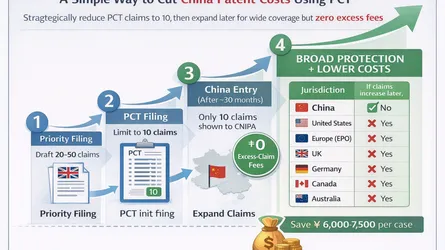
A Simple Way to Cut China Patent Costs When Using PCT — Without Giving Up Protection

Let me say something directly: most foreign companies entering China via PCT are paying more for their Chinese patents than they need to. Not because of unfair fees, and not because their technology is especially complex — but because nobody has walked them through the specific cost levers that exist in this system. This is a practical guide to those levers. Understanding Where China Patent Costs Come From Before you can cut costs intelligently, you need to know where they go. For a typical China Patent application entering via PCT, the main cost buckets are:Official CNIPA fees: Filing fees, claim surcharges, examination fees Translation fees: Chinese translation of the full specification, claims, and abstract Professional services: Attorney or agent fees for formalities, claim strategy, and prosecution management Office action responses: Costs that arise if CNIPA examiner raises objections after filingThe first three are largely determined by what you submit at national phase entry. The fourth depends on how well you handled the first three. Lever 1: Reduce Claims to 10 or Below This is the single most effective cost reduction available to most applicants, and it's often overlooked because it requires a strategic decision rather than just a procedural one. China charges an extra fee for every claim beyond the first ten. At the current CNIPA fee schedule, each additional claim costs RMB 150 extra in filing fees — and this is per claim, per application, at entry. For an application with 25 claims, that's RMB 2,250 in surcharges before prosecution even begins. Across a portfolio of 10 applications, you're looking at RMB 22,500 in preventable costs. More importantly: reducing claims forces a useful discipline. Which 10 claims actually capture what you need to protect in China? That forced prioritization almost always produces a stronger prosecution strategy. Work with a China Patent Attorney to review which claims are genuinely necessary for Chinese market protection and which are redundant or commercially irrelevant for this jurisdiction. Lever 2: Use the International Search Report to Pre-Empt Office Actions One of the underutilized advantages of PCT is that you receive an International Search Report (ISR) — typically by month 16 from your priority date — that identifies prior art relevant to your claims. Most applicants read this report once and file it away. A smarter approach: use the ISR to narrow or differentiate your claims before China national phase entry. If the ISR identified prior art that your current independent claim reads on, addressing that in your Chinese claim set before entry means you avoid the same objection being raised by a CNIPA examiner six months into prosecution — which costs you an office action response fee, attorney time, and months of delay. Pre-emptive amendment based on ISR findings is one of the clearest, lowest-cost interventions available before the 30-month deadline. Lever 3: Trim the Specification Length Where Possible China's official fees include a per-page component above a base threshold. More consequentially, translation costs are purely volume-driven. Review your international specification with a China-specific lens:Are there multiple detailed examples that describe the same embodiment with minor variations? Consolidating these reduces page count without affecting claim support. Are there sections discussing prior art in excessive detail? These may be necessary for US prosecution but add translation cost in China. Are there drawings that replicate each other with minimal difference? Each drawing page has a cost.Trimming even 20–30% of specification length can produce meaningful savings, especially for large mechanical or pharma filings where descriptions commonly run 100+ pages. Lever 4: Sequence Your Portfolio Entry Strategically If you have multiple PCT applications approaching the 30-month deadline in the same period, the sequence and grouping of national phase entries matters. Some applicants enter all applications simultaneously, paying a large lump sum of fees and translation costs in a short window. Others sequence entries across 3–6 months to smooth cash flow and allow claim review on each application before committing. More importantly: if two related applications in your portfolio cover overlapping technology, entering them simultaneously allows a single attorney review session to address both claim strategies — reducing professional fee overhead compared to treating each in isolation. What You Don't Have to Give Up The goal here is cost efficiency, not weakened protection. A 10-claim application with three tight independent claims and seven well-structured dependent claims can be more defensible in Chinese courts and licensing contexts than a sprawling 30-claim application that's never been tested. Chinese IP enforcement increasingly focuses on specific, clean claims. Clarity and focus are assets in China's court system and in licensing negotiations — not liabilities.Want a pre-entry cost review for your PCT applications? Our China Patent team provides claim strategy and cost analysis before your 30-month deadline. Speak with a China Patent Attorney today.

Practical Answers
blog-thumb
By Peter Lin/ On 15 Dec, 2025

How Much Can You Really Amend Claims When Entering China via PCT?

One of the most common questions I hear from foreign inventors entering China via PCT is: "I want to adjust my claims before the Chinese prosecution starts — how much can I actually change?" The honest answer is: more than you think in terms of scope reduction, but far less than you think in terms of new content. And the boundary between the two is where applicants get into trouble. What the Rules Say When entering China's national phase via PCT, you are technically allowed to amend your claims. CNIPA accepts amendments at national phase entry under China's Patent Law and the Implementing Regulations. But those amendments are subject to a fundamental constraint: No amendment may introduce subject matter that goes beyond the original disclosure — meaning the content of the international application as filed. This rule appears in the Chinese Patent Law broadly, and CNIPA examiners apply it consistently. The relevant standard is "beyond the original disclosure," not just "beyond the original claims." That distinction matters significantly. What You Can Do: The Permitted Range Within the no-new-matter rule, the following types of amendments are generally permitted: Narrow the independent claims. You can import limitations from your dependent claims into an independent claim, making it narrower and more specific. This is the most common and useful type of amendment at national phase entry. Delete claims entirely. Removing claims — whether to reduce fees (claims beyond 10 are surcharged) or to simplify prosecution — is permitted. You cannot, however, re-add them later without going through a formal amendment process. Combine dependent claims into a new independent claim. If a combination of features from two dependent claims is fully supported by your specification, you can combine them into a new independent claim. This is useful for creating a stronger fallback position. Correct obvious translation errors. If your Chinese translation contains an error that results in a narrower scope compared to the original PCT application, you can request correction — but only if the correction is directly and unambiguously supported by the original international filing. What You Cannot Do: The Hard Line Add features not in the original specification. If a feature was never described anywhere in your international application — not in the claims, not in the description, not in the drawings — you cannot add it to your claims at national phase entry. CNIPA will reject the amendment as introducing new matter. Broaden claim scope beyond what was disclosed. You cannot broaden an independent claim to cover subject matter that was described only as a narrower sub-case in the original application. For example, if your specification only describes an embodiment using "copper wire," you generally cannot amend the claim to read "conductive wire." Import content from prior art or external sources. Even if something is technically compatible with your invention, it must be described in the original application to be incorporated into claims. The Common Mistake: Over-Relying on What's in the Specification I see this pattern regularly: an applicant wants to amend their China Patent claims to add a feature that was mentioned in the background section or in a general statement of advantage — but never specifically claimed or described as a component of the invention. CNIPA examiners draw a tight circle around "original disclosure." A feature in the background section is not always treated as part of your invention disclosure. A general admissibility statement ("the invention may also include...") without a specific embodiment is often not enough to support a claim amendment. The lesson: your specification's disclosure quality, written at the time of the original PCT filing, determines your amendment latitude in China — often 28+ months later. Practical Strategy: Front-Load Your Disclosure The best way to maximize your amendment options in China is to draft your international application with China specifically in mind:Include multiple specific embodiments in the description, not just one or two. Write out dependent claims carefully — each one represents a fallback position you can later elevate into an independent claim. Avoid overly narrow "examples" without broader claim support language.A China Patent Attorney can review your existing PCT application and identify which amendments are genuinely available to you before national phase entry — and which wishlist items are off the table. What About Article 34 Amendments? Before entering the national phase, you may also have used PCT Article 34 to request preliminary examination and amend claims internationally. Those amendments, if already incorporated into your PCT application, become the new baseline for China national phase entry. However, China is not obligated to accept them if they introduced new matter by PCT standards — and CNIPA performs its own assessment.Need to review your PCT application before China national phase entry? Our China Patent specialists can audit your pending PCT applications and advise on amendment strategy. Or speak directly with a China Patent Attorney about your specific filing.