




A Patent in Hand Does Not Mean a China Market Exists
One of the most common assumptions I see from inventors is this:
“I have a patent, so there should be a licensing opportunity in China.”
I understand why people think that way. A patent feels like proof. It is formal. It is expensive. It reflects effort, legal work, and technical substance.
But in commercial reality, especially when dealing with China-facing licensing or manufacturing discussions, a patent is only one part of the picture.
It is not the market.
It is not demand.
And it is not, by itself, a reason for a Chinese company to engage.
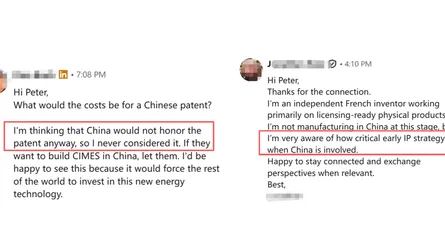
What inventors are actually asking me
I have received messages like these:
“I wanted to ask whether any manufacturers, industrial groups, or trusted contacts in China come to mind for this type of opportunity.”
And:
“I am interested in a potential licensing or royalty-based partnership…”
And in another case, a client wanted help positioning patented helmet and wearable technologies to Chinese companies, while also asking what proof-of-concept examples could make the pitch credible in China.
These are not unreasonable questions. But they often begin one step too late.
The hidden assumption is that patent ownership has already solved the biggest uncertainty.
It has not.
What a Chinese company is usually evaluating
When a manufacturer, brand owner, or business development team in China looks at a foreign invention, they are usually not asking first, “Is there a patent?”
They are asking:
- Is there a market?
- Is there a product category I understand?
- Is there evidence that users care?
- Can this be produced, tested, sold, or integrated into an existing business line?
- Why should we spend time on this now?
A patent may support the discussion. But it rarely creates the discussion.
Why this gap matters so much
A lot of inventors come from a legal or technical mindset. They believe novelty should carry the opportunity.
But Chinese counterparties, especially on the commercial side, usually respond to a different logic:
- practical use
- production feasibility
- category fit
- cost logic
- sales potential
- proof from the market
If those elements are missing, even a technically interesting patent may receive little attention.
Three practical examples of the gap
1. The broad humanitarian invention
A project may sound meaningful and ambitious, but if the target market, product channel, and commercial buyer are unclear, China outreach becomes abstract. You are not presenting a deal. You are presenting a possibility.
2. The early-stage consumer product concept
A founder may have a patent-backed idea for a mount, wearable, or accessory. But if there is no prototype, no customer evidence, and no clear target company profile, the project remains too early for serious China licensing conversations.
3. The technically impressive but commercially unproven portfolio
Even where patents exist across multiple filings, the real question remains the same: what concrete product path proves that the technology already maps to something buyers want?
Without that bridge, the IP may be impressive, but the market signal stays weak.
What inventors should ask instead
Instead of starting with “I have a patent, who in China should I talk to?” the better questions are:
- What specific commercial problem does this solve?
- Which type of Chinese company would understand it fastest?
- What evidence makes this more than a technical claim?
- Is this closer to licensing, contract manufacturing, joint development, or market testing?
- What would a skeptical buyer need to see before taking a meeting seriously?
Those questions are much less romantic. But they are much more useful.
Patent value still matters — just not by itself
None of this means patents are unimportant. On the contrary, patents may be critical for:
- defining ownership
- protecting core features
- supporting negotiation leverage
- preventing careless disclosure
- making future licensing more credible
But they work best when paired with something else: market proof, product readiness, or a strong commercial narrative.
My practical conclusion
When foreign inventors think about China, they should stop treating patent ownership as the finish line.
It is better understood as part of the foundation.
A patent can support a real opportunity. It does not automatically create one.
That distinction matters because it changes what should happen next.
Sometimes the next step is China filing. Sometimes it is manufacturing preparation. Sometimes it is market validation. Sometimes it is simply admitting that the project is not ready yet.
That is not bad news. It is just honest news.
And in cross-border business, honest sequencing saves time.