Missed the Hong Kong Re-Registration Window: Can Standard Patent (O) Still Help?
Missed the Hong Kong standard patent (R) deadline after filing in China or via PCT? Learn when standard patent (O) may still help, and when it may already be too late.
What is the difference between a China patent and a Hong Kong patent? Learn the key differences in territory, patent types, filing routes, protection term, and follow-on filing strategy.
A practical guide to filing in Hong Kong after a China patent filing or PCT entry into China. Learn the best route, the two-stage system, and the key 6-month deadlines.
PCT translation errors in China can permanently affect patent scope. This guide explains what can be corrected, when, and how the PCT and Paris routes differ.
A practical guide for foreign applicants deciding whether invention patent filing, utility model filing, or a dual-track strategy makes more sense in China.
Sarah had 31 months from her priority date and a PCT application that hadn't been reviewed for Chinese-specific risk. Peter Lin walks through the 45 days they worked together — and the four lessons every foreign inventor should take from it.
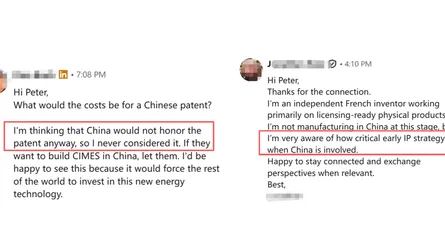
One inventor ignored China entirely. Another wanted to file everywhere at once. Peter Lin explains why both instincts fall short — and what a strategic approach to China patent protection actually looks like.
A translation error in your PCT Chinese application can silently narrow the scope of your patent — sometimes permanently. Peter Lin explains how CNIPA handles correction requests, what the standard really is, and why prevention matters far more than remedy.
A US Provisional Patent Application (PPA) is a smart starting move — but using it as the priority basis for China requires getting three specific details right. Peter Lin explains what goes wrong when founders skip these steps.
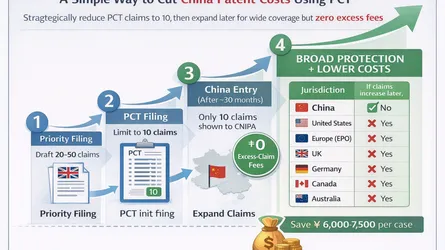
Many applicants entering China via PCT pay significantly more than they need to. Not because the fees are unavoidable — but because nobody walked them through the levers that exist. Peter Lin outlines a straightforward approach to reducing China patent costs without sacrificing meaningful protection.
Amending claims when you enter China's national phase via PCT sounds straightforward — but CNIPA applies strict "no new matter" rules that trip up many applicants. Peter Lin explains what's actually permitted, what gets rejected, and how to amend smartly.
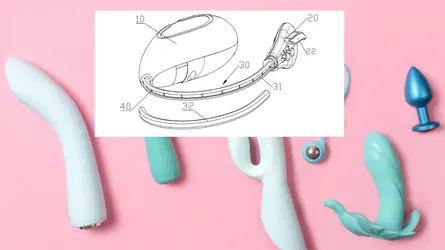
On Reddit, people often ask: why do adult product (or “adult wellness”) patents get rejected so easily in China? As someone who’s been deep in the patent world for years, let me break it down.
When you enter China's national phase via PCT, a set of costs gets locked in based on decisions you made months or years earlier. Peter Lin explains what drives those costs — and how to structure your PCT application to avoid unnecessary expense before you even start prosecution.
Twelve months. Thirty months. These two deadlines define your entire China patent window — and confusing them can cost you rights you can never recover. Peter Lin breaks down exactly what happens at each deadline and how to use both strategically.
Both the Paris Convention and PCT let you claim priority when filing in China — but the rules, deadlines, and strategic implications are very different. Peter Lin explains the one distinction that can make or break your China filing.
Most inventors file a PCT application with broad claims — then arrive at China's national phase unprepared for the cost and complexity. Peter Lin explains the "slimming strategy": a focused, cost-effective way to enter China via PCT that protects what matters most.
Choosing between a provisional and a non-provisional patent matters more than most founders realise. Here is a plain-language breakdown to help you decide.
As I sit on a high‑speed train to Xiamen to meet with clients, I’m writing this post because I’ve been getting the same question lately from international founders: “How can I protect my idea in China before it’s even ready for market?” In the U.S., many startups rely on a provisional patent application. It’s like a placeholder that locks in your filing date for 12 months while you refine your product. It’s affordable, flexible and gives you breathing room to perfect your design. But China plays by different rules. There is no provisional system. So what can you do? The answer lies in a unique strategy: filing a utility‑model patent and an invention patent at the same time.

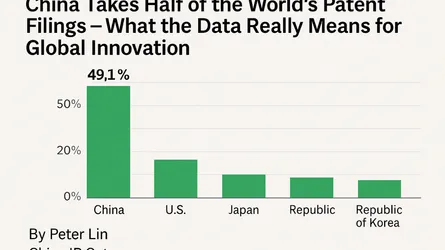
WIPO's 2025 IP facts show China filed 49.1% of the world's patents. But what does that dominance actually mean for your IP strategy?