A Simple Way to Cut China Patent Costs When Using PCT — Without Giving Up Protection
Let me say something directly: most foreign companies entering China via PCT are paying more for their Chinese patents than they need to. Not because of unfair fees, and not because their technology is especially complex — but because nobody has walked them through the specific cost levers that exist in this system.
This is a practical guide to those levers.
Understanding Where China Patent Costs Come From
Before you can cut costs intelligently, you need to know where they go. For a typical China Patent application entering via PCT, the main cost buckets are:
- Official CNIPA fees: Filing fees, claim surcharges, examination fees
- Translation fees: Chinese translation of the full specification, claims, and abstract
- Professional services: Attorney or agent fees for formalities, claim strategy, and prosecution management
- Office action responses: Costs that arise if CNIPA examiner raises objections after filing
The agency fee for PCT national phase entry in China starts at USD 500. Official fees and translation fees are quoted separately.
Lever 1: Review the Claim Set
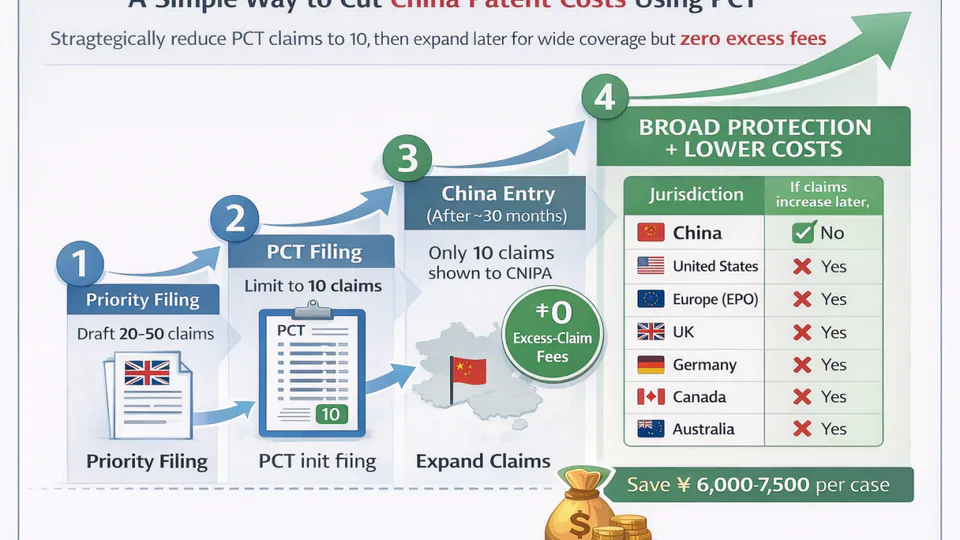
Send the original claim set and any international amendments when discussing costs. Your agent can identify the claims that matter commercially and check the official fees applicable to the application.
Work with a China Patent Attorney to review which claims are genuinely necessary for Chinese market protection and which are redundant or commercially irrelevant for this jurisdiction.
Lever 2: Use the International Search Report to Pre-Empt Office Actions
One of the underutilized advantages of PCT is that you receive an International Search Report (ISR) — typically by month 16 from your priority date — that identifies prior art relevant to your claims. Most applicants read this report once and file it away.
A smarter approach: use the ISR to narrow or differentiate your claims before China national phase entry.
If the ISR identified prior art that your current independent claim reads on, addressing that in your Chinese claim set before entry means you avoid the same objection being raised by a CNIPA examiner six months into prosecution — which costs you an office action response fee, attorney time, and months of delay.
Pre-emptive amendment based on ISR findings is one of the clearest, lowest-cost interventions available before the 30-month deadline.
Lever 3: Confirm the Translation Scope
Application length affects the cost of translation. Give the filing agent the original specification, claims, abstract, drawings and any international amendments. Once the agent identifies the required texts, you can review the translation quote before giving filing instructions.
Lever 4: Sequence Your Portfolio Entry Strategically
If you have multiple PCT applications approaching the 30-month deadline in the same period, the sequence and grouping of national phase entries matters.
Some applicants enter all applications simultaneously, paying a large lump sum of fees and translation costs in a short window. Others sequence entries across 3–6 months to smooth cash flow and allow claim review on each application before committing.
More importantly: if two related applications in your portfolio cover overlapping technology, entering them simultaneously allows a single attorney review session to address both claim strategies — reducing professional fee overhead compared to treating each in isolation.
What You Don’t Have to Give Up
The goal here is cost efficiency, not weakened protection. A 10-claim application with three tight independent claims and seven well-structured dependent claims can be more defensible in Chinese courts and licensing contexts than a sprawling 30-claim application that’s never been tested.
Chinese IP enforcement increasingly focuses on specific, clean claims. Clarity and focus are assets in China’s court system and in licensing negotiations — not liabilities.
Want a pre-entry cost review for your PCT applications?
Our China Patent team provides claim strategy and cost analysis before your 30-month deadline. Speak with a China Patent Attorney today.