





Paris Convention vs. PCT in China: A Critical Difference Most Inventors Miss
Last year a Dutch hardware startup came to me eight months after filing their first patent in the Netherlands. They had a working product, a potential distributor in Shenzhen, and a growing sense that they should probably protect something in China. Eight months was still within the Paris Convention window. But when I asked whether they had a finalized Chinese translation of their specification ready to file, the answer was no — and their September launch timeline meant four months were the most they could realistically get.
That conversation is where the Paris Convention versus PCT question becomes real. In theory, both routes let you claim your Netherlands filing date as your priority date in China. In practice, only one of them gave this team the time they actually needed. The two main options are the Paris Convention direct route and the PCT route, and in China specifically, there are differences that can significantly affect your cost, timeline, and final patent scope.
The Basic Framework
Both routes allow you to claim the priority date from your original domestic filing when you eventually file in China. That priority date matters enormously in China’s first-to-file system — it determines whether you beat a competitor to protection rights.
- Paris Convention route: File directly in China within 12 months of your first filing date.
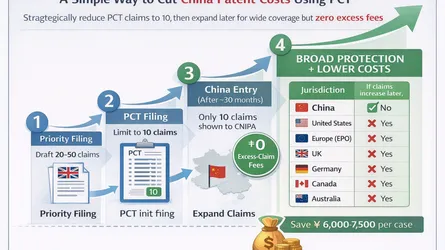
- PCT route: File an international PCT application (within 12 months of your first filing), then enter China’s national phase within 30 months of your priority date.
That extra 18 months the PCT route provides is not just a filing convenience. It’s a strategic window that most inventors underuse.
The Critical Difference Most Miss
Here’s what I see inventors get wrong again and again:
When you file directly into China via the Paris Convention route, you must have a fully translated Chinese application ready within 12 months. That means your specification, claims, and abstract — all in Chinese — submitted together with your filing fee.
For an early-stage startup, 12 months from first filing is often not enough time to finalize your design, assess the Chinese market, or arrange quality translation.
The PCT route, by contrast, lets you delay that commitment. You file the international PCT application in your own language (typically English), and the Chinese translation only needs to be submitted when you enter the national phase at month 30. That’s an additional 18 months to refine your claims, secure funding, or assess whether China is worth the investment.
Why China Specifically Amplifies This Gap
Many PCT member countries accept English filings even at national phase entry. China does not. CNIPA requires a full Chinese translation of your application at national phase entry. A poor translation can cost you claim scope — permanently.
Under Chinese patent practice, if there is a discrepancy between the original PCT application and the Chinese translation, CNIPA will generally rely on the Chinese translation as the basis for examination. This makes translation quality a strategic issue, not just a clerical one.
The extra time the PCT route provides lets you commission and review a professional-grade translation — rather than rushing one through in the final weeks before a 12-month Paris Convention deadline.
The Trap: Assuming PCT Is Always Better
PCT is not universally superior. Here’s when the Paris Convention direct route makes more sense for China Patent filings:
- You are confident about the Chinese market now. If you have a distribution partner, manufacturing arrangement, or real commercial activity in China within 12 months, you may not need the extra time.
- Your technology is simple and the application is short. Translation cost and risk are proportional to specification length. A 10-page utility application translates much faster and more reliably than a 100-page biotech filing.
- You want to avoid PCT fees. PCT filing has its own international fee structure. If you’re early-stage and China is your only international target, the direct route may be cheaper overall.
What a China Patent Attorney Will Actually Tell You
When I advise clients as a China Patent Attorney, this is the question I always ask first: How confident are you today about what your Chinese patent needs to protect?
If the answer is “very confident, and we have a product ready to launch,” the Paris Convention route is often fine.
If the answer is “we think China matters but we’re still refining the product,” the PCT route is almost always the right choice — not for the extra protection it adds, but for the strategic flexibility it buys.
A Simple Decision Framework
| Situation | Recommended Route |
|---|---|
| Product is final, China launch within 12 months | Paris Convention direct |
| Still refining design or claims | PCT → China national phase |
| Multiple countries beyond China | PCT (efficiency of one filing) |
| Budget-constrained, China only | Paris Convention (lower upfront cost) |
| Complex specification, translation risk | PCT (more time for quality translation) |
Have questions about your China patent filing strategy?
Explore our China Patent services or speak with a China Patent Attorney about whether Paris Convention or PCT is the right route for your situation.