




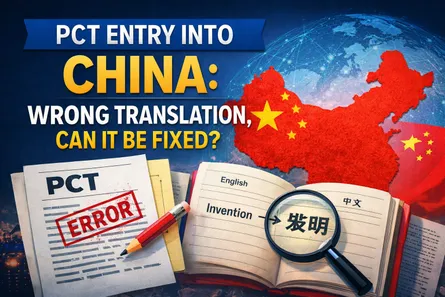
PCT Translation Errors in China: What Foreign Applicants Can Correct, and When
Most foreign applicants submit a PCT translation into Chinese and move on. The translation is outsourced, filed under deadline pressure, and rarely reviewed against the original international application text. In many cases it is fine. But in a meaningful number of cases it is not — and when a translation error in China patent prosecution affects claim scope, the consequences can be permanent. This guide explains what correction is actually available, when it must happen, what makes a change qualify as a genuine translation correction versus an amendment, and how the situation differs depending on how you filed in China in the first place. Why This Issue Matters More Than Most Foreign Applicants Expect Translation in patent work is not a purely linguistic task. It makes legal commitments. A Chinese translation of a PCT application becomes the operative text for prosecution in China — and eventually for enforcement. If the translation unduly narrowed a claim because a technical term was rendered too specifically, or if a feature was added that was not in the original, the Chinese patent that results will not accurately reflect what the applicant actually invented. The commercial stakes are real. An overly narrow claim in China may fail to catch a competitor whose product would clearly have fallen within the scope of the original English claims. A translation that introduced a feature not in the original could expose the patent to an invalidity challenge after grant. Neither outcome is easy to manage, and neither is cheap to fix if it is fixable at all. What foreign applicants often miss is that unlike some jurisdictions where post-grant correction is relatively accessible, China's system is comparatively unforgiving once a patent is granted. The windows to act exist — but they close, and they do not reopen. First, Separate Two Very Different Situations: PCT Entry vs Paris Filing The most important distinction to establish before anything else is this: how did you file in China? If you filed an international application under the PCT and later entered China national phase using a Chinese translation of that international application, you are in a different legal situation from someone who filed a Paris Convention direct application in Chinese from the start. For PCT national phase entries, Chinese law recognises that the Chinese translation is not the original — the international application filed with the receiving office is. This creates space for a translation correction mechanism, because there is a defined reference text against which the Chinese translation can be checked. The rules governing PCT entry into China — filing timelines, language requirements, and the translation submission process — are described in more detail in the guide on 12 vs. 30 months and the critical windows for China patent protection. For Paris Convention direct filings in Chinese, the Chinese text you filed is the original. There is no foreign-language source to correct against. General amendment rules apply, and translation correction as a concept does not exist. These two routes operate under different rules and require different approaches to error management. Conflating them is one of the more consequential mistakes in managing a China patent portfolio. What China Usually Allows for PCT Translation Corrections China's Patent Law Implementing Regulations provide that where an international application was filed in a foreign language and the Chinese translation deviates from the original international application, the applicant may request that CNIPA amend the Chinese text to conform to the original. The governing standard in practice: the correction must be based on the text of the original international application as filed at the PCT receiving office — the International Bureau's record of the application as it existed on the international filing date. Later amendments made during the international phase, whether through Article 19 (claims amendments) or Article 34 (examination amendments), are not automatically the baseline unless those amended texts were formally designated for entry into China. The purpose of this mechanism is narrow. It is designed to restore accuracy — to bring the Chinese text into alignment with what the original actually said. It is not a vehicle for improving claim coverage, responding to prior art identified during prosecution, or adding technical content that was not in the original disclosure. The Two Time Windows That Matter In practice, there are two main moments when a translation correction in China is realistically pursued. Window one: voluntary correction before CNIPA raises a concern. A translation correction request can be filed at any point before the patent is granted. In practice, the earlier the better — ideally before or at the start of substantive examination, before the examiner has relied on the translated text to form any view on the claims or the disclosure. Some applicants with significant China patent programs now conduct a brief translation review of claim language shortly after national phase entry, specifically to catch material errors at this early stage. The cost of doing so is a fraction of the cost of managing the consequences later. Window two: in response to an Office Action. CNIPA examiners do occasionally identify apparent inconsistencies between the Chinese claim language and what the description suggests the invention actually is. Where the underlying reason is a translation error, this is often the first moment a foreign applicant becomes aware of the problem. The response period to the Office Action then becomes the operative correction window. Missing it, or filing a response that does not properly address the translation issue, can produce a permanent narrowing. What there is not, in most cases, is a meaningful correction window after the patent has been granted. Post-grant correction in China is procedurally difficult and not generally available as a practical remedy for scope problems that trace to translation errors. What Usually Counts as a Real Translation Error Not every disappointing outcome in a Chinese patent claim reflects a translation error. The concept has a defined meaning. Translation errors that typically qualify for correction include: Linguistic divergence from the original — where a technical term was rendered using a Chinese expression that carries a different scope or meaning from the original, and the correct translation is objectively clear when the two texts are read side by side. Structural inversions — where a sentence in the original describes a limitation as optional but the Chinese translation rendered it as mandatory, or vice versa, in a way that clearly misrepresents the original syntax. Omissions — where a phrase or clause clearly present in the original was dropped from the Chinese translation, and the omission is visible without any interpretive judgment. The unifying principle is objective: the Chinese text should have said something specific, it did not because of a translation failure, and the original supports the proposed correction without needing to read anything into it. What Usually Does Not Qualify The limits of translation correction are regularly tested, usually by applicants who want to recover claim scope for reasons that are not about translation fidelity. Adding a technical feature not present in the original international application does not qualify, even if the inventor believes it would strengthen the claims or better describe the actual product. This is new matter, not linguistic restoration. Expanding claim scope in a direction the original text does not straightforwardly support similarly falls outside the mechanism. CNIPA will assess whether the proposed correction reflects what the original actually said. If the correction requires reading the original in a way that is not objectively supported by its text, it will be treated as an amendment rather than a correction — and assessed under more restrictive rules. Using "translation correction" to clean up informal or imprecise expression in the original description is also not available. The mechanism corrects the Chinese rendering of a text; it does not improve the underlying text itself. The practical test is reasonably direct: would a competent translator, working carefully from the original, have produced the corrected Chinese text? If the answer requires a fresh technical or legal judgment rather than a straightforward linguistic reversal, the proposed change is unlikely to be accepted as a mere translation correction. Translation Correction vs Ordinary Amendment These are two distinct mechanisms, and the distinction has substantive consequences. A translation correction, when accepted, is treated as restoring what the original text actually said. The corrected Chinese text is read as having been the correct translation from the outset — it changes the operative text of the application back to what it should have been. An ordinary amendment under China Patent Law is subject to a different and more limiting standard: it cannot introduce content that goes beyond the scope of what was disclosed in the original application. Crucially, for PCT cases, the baseline for amendment purposes is the Chinese translation as originally submitted — not the original foreign-language international application. If your Chinese translation is narrower than the original, you generally cannot use an ordinary amendment to recover the broader scope, because the narrower Chinese translation is what CNIPA treats as defining the disclosure for amendment purposes. This asymmetry is what makes the translation correction mechanism so important: if a material narrowing error is not caught and corrected within the translation correction framework, ordinary amendment may not be sufficient to fix it at all. The scope is simply gone. For a related discussion of how amendment rules work in PCT cases more broadly, the guide on how much you can amend claims when entering China via PCT covers the "no new matter" rules and common mistakes in detail. What About Paris Convention Direct Filings? For a Paris Convention direct filing in Chinese, the Chinese text filed is the original application. There is no foreign-language reference document from which a translation correction can be requested. The general amendment rules under China Patent Law apply. Voluntary amendments can be made within a defined early window after filing. Amendments in response to Office Actions are permitted within the prescribed response periods. In both cases, the governing constraint is the same: amendments cannot introduce technical content beyond the scope of the original disclosure. Since the Chinese text is the original, the question of what "the original said" and what the translation "should have said" simply does not arise. In practice, Paris Convention direct filings into China are typically prepared in Chinese from the start by a China-registered patent attorney, and the national-phase translation problem does not apply in the same form. The risks are of a different character — incomplete disclosure, claim language that does not match the description, terminology inconsistencies — and they are addressed through the general amendment process rather than any translation-specific mechanism. What Happens If You Do Nothing? If a translation error is identified but not acted on, the consequences depend on the nature of the error and where the application is in its lifecycle. An error that narrowed the claims and was never corrected may result in a patent that grants with claims too narrow to be useful — and with no mechanism to recover the original scope after grant. The commercial asset the applicant expected to hold in China may be materially weaker than anticipated. An error that introduced content not in the original, if identified by CNIPA during examination, will produce an objection that the claims or description lack support in the original. If the error is identified only after grant, by a third party seeking to challenge the patent, it can form the basis of a well-founded invalidation action. An error that distorts the meaning of a technical feature creates prosecution history risks: CNIPA's examination record reflects the Chinese text, including the error, and this record is relevant to later infringement analysis. A patentee relying on a Chinese claim that diverges from the original may face difficult questions about scope and intent. The real risk of inaction is not always visible during prosecution. Applications often grant without the translation error being raised. The consequences surface when the patent is needed — in enforcement, licensing, or a dispute — and by then the correction window is long closed. A Simple Internal Review Method for Foreign Applicants Foreign applicants managing a China patent portfolio with PCT entries can reduce translation-related risk with a straightforward internal review practice. After receiving confirmation of national phase entry and the Chinese filing documents, request a reverse translation of the claims: a translation from the Chinese claims back into English, done by someone who has not seen the original English claims. Then compare this reverse translation against the original international application claims side by side. Differences in scope, omitted elements, and structural inversions typically become visible in this exercise without requiring deep technical expertise. The review is not looking for every nuance — it is looking for material divergences that could affect what the patent actually covers. Where a material divergence is identified, consult with a China patent attorney on whether the issue qualifies for a translation correction, an ordinary amendment, or requires a different strategy. The earlier this consultation happens after national phase entry, the more options are available. This practice is not a substitute for a full professional review of the description and drawings — but for claim scope, which is where translation errors most often cause commercial harm, it is a practical and low-cost step that a significant number of applicants currently skip. For those still evaluating whether and when to enter China via PCT — including the timing decisions that affect which correction tools are even available — the PCT national phase slimming strategy guide covers the strategic framework for that earlier decision. Final Takeaway Translation errors in China patent applications are not rare, and they are not always visible during prosecution. For PCT national phase entries, Chinese law offers a correction mechanism — but it is bounded. It requires a genuine translation error. It requires the proposed correction to be grounded in the original international application text. And it has time windows that close before grant and do not reopen. What foreign applicants need most is not a comprehensive map of every procedural rule, but a practical habit: review the Chinese translation of your claims after national phase entry, before substantive examination begins. If something looks materially wrong against the original, act early. The cost of a translation correction request at that stage is a fraction of what it costs to manage a scope problem after grant — or to lose the scope entirely. If you are working through a China patent filing and have questions about translation review, national phase entry strategy, or claim scope, the China Patent Filing and China Patent Attorney pages describe how we work with foreign applicants on these questions directly.