




Type something to search...
China Trademark Registration Guide 2024: Everything You Need to Know

China Trademark Registration Guide 2024: Everything You Need to Know

Understanding China’s trademark system is crucial for any international brand entering the Chinese market. This comprehensive guide covers everything you need to know about trademark registration in China in 2024.

Why Trademark Protection Matters in China

China operates on a “first-to-file” system, meaning whoever files first owns the trademark rights—regardless of who used it first internationally. This has led to numerous cases of trademark squatting, where local entities register famous foreign brands before the actual brand owner does.

Notable Examples

  • New Balance lost their Chinese trademark and had to pay $16 million
  • Michael Jordan fought a 7-year legal battle over his Chinese name
  • Tesla’s trademark was initially registered by a Chinese businessman

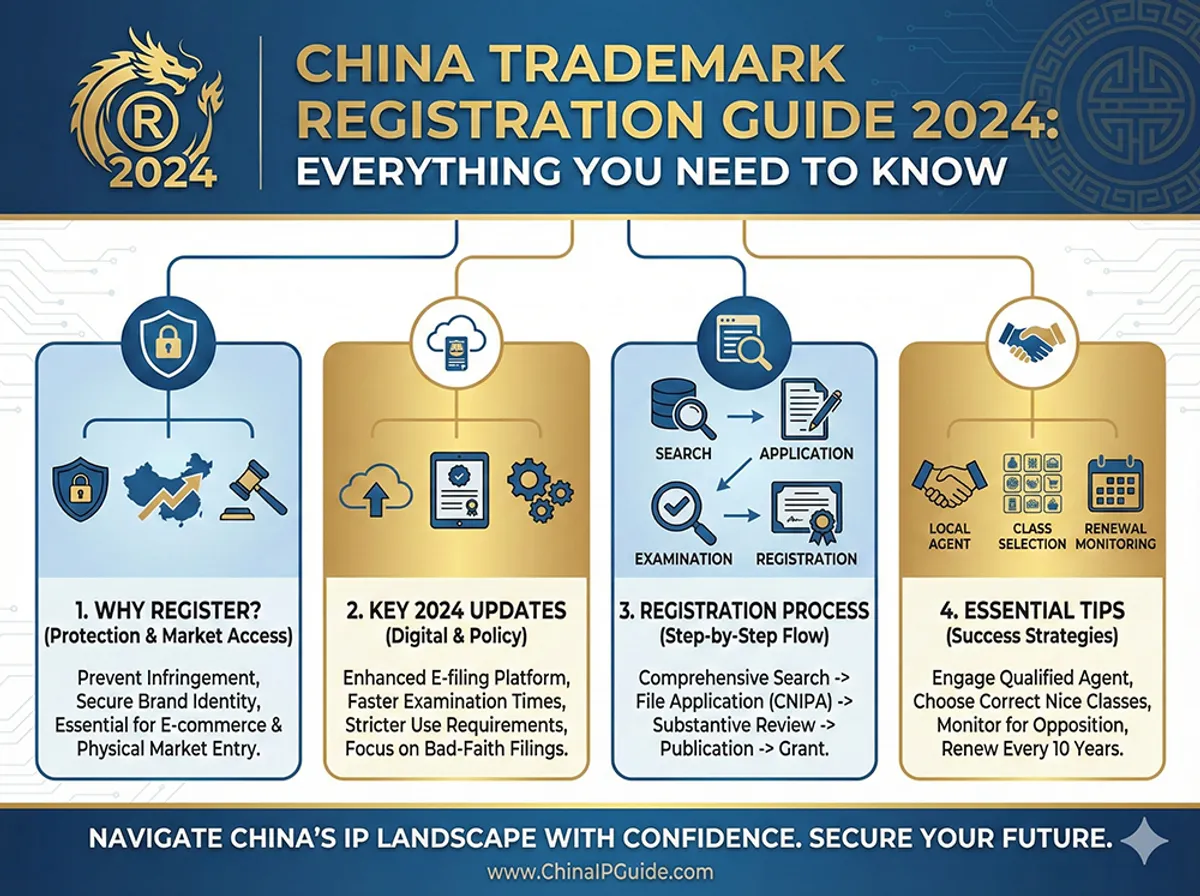
The Chinese Trademark Registration Process

Step 1: Comprehensive Search (2-3 weeks)

Before filing, conduct thorough searches across:

  • Exact matches in all 45 Nice Classification classes
  • Phonetic similarities in Chinese
  • Visual similarities in logos
  • Translation variations

Pro Tip: Chinese consumers often create their own translations of foreign brand names. Search for these “folk translations” to avoid conflicts.

Step 2: Chinese Name Selection

Choosing the right Chinese name is critical. Consider:

  • Phonetic similarity to your original name
  • Positive meaning in Chinese
  • Cultural appropriateness
  • Memorability for Chinese consumers

“The China IP Gateway team helped us build a full defensive trademark strategy. The dashboard showed real-time updates.” - Kenji Tanaka, Luminex Japan

Step 3: Multi-Class Filing Strategy

Most brands need protection in multiple classes:

  • Core classes: Your actual products/services
  • Defensive classes: Adjacent categories where infringement is likely
  • E-commerce classes: Class 35 for online retail is essential

Step 4: Application Filing (1-2 weeks)

Required documents:

  • Application forms for each class
  • Clear trademark specimens
  • Applicant identification documents
  • Power of Attorney

Step 5: Examination (9-12 months)

CNIPA (China National Intellectual Property Administration) reviews your application for:

  • Absolute grounds (descriptiveness, prohibited marks)
  • Relative grounds (conflicts with existing marks)

Step 6: Publication & Registration (3 months)

If approved, your trademark is published for opposition. If no opposition is filed within 3 months, you receive your registration certificate.

Total Timeline: 12-15 months

Pricing Structure

Basic Registration: USD 600-900 per class

  • Includes search, filing, and official fees
  • Monitoring during examination
  • Certificate delivery

Comprehensive Protection Package: Custom pricing

  • Multi-class registration
  • Defensive filing strategy
  • Chinese name consultation
  • Ongoing monitoring

Common Challenges & Solutions

Challenge 1: Similar Existing Marks

Solution: File in specific subclasses or modify your mark slightly while maintaining brand identity.

Challenge 2: Descriptive Terms

Solution: Add distinctive elements or create a coined term that’s unique to China.

Challenge 3: Translation Issues

Solution: Work with native Chinese trademark experts who understand both linguistic and cultural nuances.

Best Practices for International Brands

  1. File Early: Before entering the market or making announcements
  2. File Broadly: Cover all relevant classes from the start
  3. Monitor Actively: Set up trademark watching services
  4. Enforce Consistently: Take action against infringers quickly
  5. Use Professional Help: The cost of mistakes far exceeds professional fees

Post-Registration Maintenance

  • Renewal: Every 10 years
  • Use Requirements: Use within 3 years to avoid cancellation
  • Record keeping: Maintain evidence of use
  • Customs recordation: Register with Chinese customs for border enforcement

Conclusion

Trademark protection in China requires proactive planning and expert guidance. With the right strategy, you can secure strong protection for your brand in the world’s largest consumer market.

Ready to protect your brand in China? Contact our trademark experts for a free consultation.

Related Posts

Protect Your Idea
blog-thumb
By China IP Gateway/ On 01 Dec, 2025

How to Protect Your Idea Quickly in China: A Personal Note from the Train

🇨🇳 Why Dual Filing Works in China A utility‑model patent covers structural or mechanical improvements and typically grants within about six months. Think of it as a quick shield. It gives you an enforceable right early, so you can show investors, partners and even Customs officials that your design is protected. Meanwhile, you simultaneously file a full invention patent, which takes longer but provides stronger, broader protection once it is granted. By starting them both together, you protect yourself at two speeds: fast and long‑term. Once the invention patent is issued, you can withdraw the utility model to avoid double. 🔍 Does it suit every innovation? This strategy shines for hardware or structural improvements—think product casings, mechanical components, new configurations or machinery. For software, algorithms or purely digital inventions, you still need to go through the standard invention patent route (which takes time), and other IP tools like copyright or trade secrets may be more appropriate. 🚀 My advice to fellow founders Don’t wait for perfection. File early, iterate quickly. In China’s “first to file” system, speed matters. Leverage the fast and slow lanes. A utility model buys you time; the invention patent keeps your protection strong for the long run. Tell your story. Investors and partners respond better when you can show that you’ve taken proactive steps to secure your IP, rather than saying “we’re working on it.” As someone who’s helped many startups navigate this path, I know first‑hand how disheartening it is to see a good idea copied simply because the filing happened too late. Don’t let that be your story. If your products touch China, your protection strategy should too. Feel free to reach out if you’d like help planning your IP filings or understanding which options best fit your product. Safe travels and safe ideas!

Patent Protection
blog-thumb
By Peter Lin/ On 15 Oct, 2024

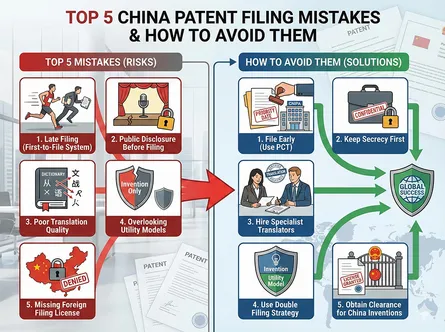
5 Critical Mistakes to Avoid When Filing Patents in China

When filing patents in China, many international companies make costly mistakes that could have been easily avoided. Based on our decade of experience handling 3,000+ IP cases, here are the five most critical errors and how to prevent them. 1. Waiting Too Long to File China operates on a strict "first-to-file" system. Unlike the US grace period, any public disclosure before filing can invalidate your patent application. We've seen companies lose patent rights simply because they presented at a conference before filing. Solution: File your Chinese patent application before any public disclosure, trade show, or academic publication. Consider filing provisionally to secure your priority date. 2. Using Direct Translation Without Technical Review Patent terminology requires precision. Direct translations often miss technical nuances or use incorrect Chinese technical terms, leading to weak patent claims or office action rejections. Solution: Work with IP professionals who combine technical expertise with translation skills. Our team includes Ph.D.-level experts who understand both the technology and Chinese patent terminology."Their backend QA system caught an error in our drawings that even our internal team missed. That's real expertise." - Dr. Andreas Müller, BioPhoton GmbH3. Ignoring the Patent Prosecution Highway (PPH) Many companies don't realize they can accelerate Chinese patent examination from 18-24 months down to 6-8 months using PPH, if they have corresponding patents in other jurisdictions. Solution: If you have granted or allowed patents in the US, Europe, Japan, or Korea, leverage PPH to fast-track your Chinese applications. This can save significant time and costs. 4. Filing Too Broad or Too Narrow Some companies file overly broad claims that get rejected, while others file too narrowly and miss protection opportunities. Both approaches waste time and money. Solution: Conduct thorough prior art analysis specific to China's patent database. Our strategic approach balances strong protection with realistic grant expectations. 5. Neglecting Portfolio Management Filing a patent is just the beginning. Without proper maintenance, renewal tracking, and strategic portfolio review, companies lose protection inadvertently or waste money on unnecessary patents. Solution: Use a systemized platform for tracking deadlines, renewals, and portfolio strategy. Our dashboard provides real-time visibility into your entire China IP portfolio. Key TakeawaysFile before any public disclosure Use technical experts for translations Leverage PPH when possible Balance claim scope strategically Implement systematic portfolio managementReady to protect your innovations in China the right way? Book a consultation with our patent experts today.