




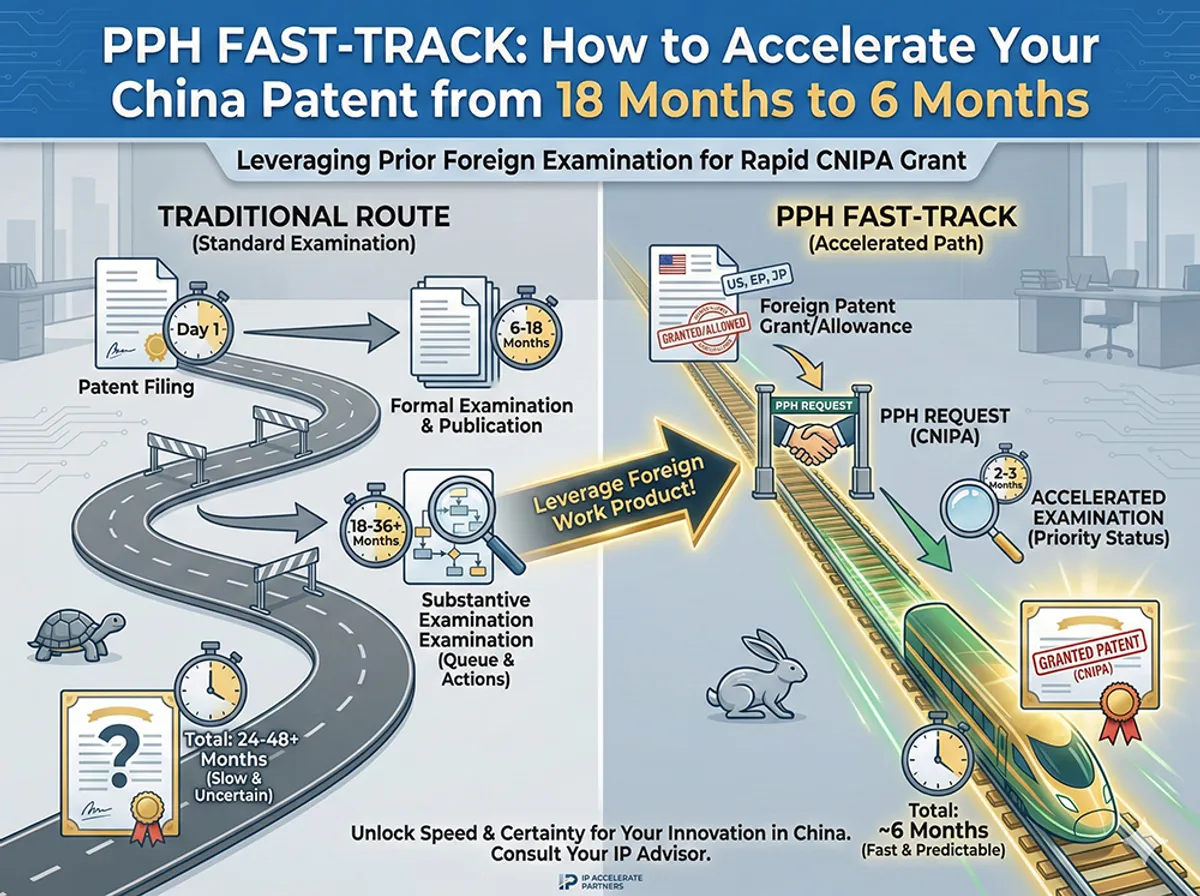
PPH Fast-Track: How to Accelerate Your China Patent from 18 Months to 6 Months
The Patent Prosecution Highway (PPH) is one of the most powerful tools for accelerating patent examination in China, yet many international companies don’t know it exists or how to use it effectively. This guide explains everything you need to know about leveraging PPH for your China patents.
What is PPH?
The Patent Prosecution Highway is an international framework that allows patent applicants to fast-track examination in participating countries based on positive examination results from another patent office. China has PPH agreements with over 30 countries including the US, Europe, Japan, and Korea.
Why PPH Matters for China Patents
Traditional Timeline
- Filing to First Office Action: 12-18 months
- Total time to grant: 24-36 months
- Multiple examination rounds common
PPH Timeline
- Filing to First Office Action: 2-4 months
- Total time to grant: 6-12 months
- Fewer examination rounds
“Peter and his team guided us through the PPH route, and our first CN patent was granted in 6 months — faster than we expected.” - Alex Johnson, GreenCell Robotics
Eligibility Requirements
To use PPH for your China patent application, you must have:
- A corresponding application in a PPH partner country (US, EP, JP, KR, etc.)
- At least one allowed claim in the partner country application
- Matching claims between the foreign and Chinese applications
- Not yet started substantive examination in China (for most PPH types)
Types of PPH Available in China
1. PPH MOTTAINAI (Standard PPH)
Based on allowed claims from a single foreign application. Most commonly used route.
2. PCT-PPH
Based on positive reports from PCT International Search or Examination. Particularly useful for startups filing internationally.
3. IP5 PPH
Accelerated cooperation between the five largest patent offices (US, EP, JP, KR, CN). Offers the fastest track.
Step-by-Step PPH Filing Process
Step 1: Prepare Your Foreign Application
Ensure you have:
- Allowance notice or positive examination report
- Copy of allowed claims
- Examination history documents
Step 2: File Chinese Application
If not already filed, file your Chinese patent application via:
- Paris Convention route (within 12 months of priority)
- PCT national phase entry (within 30/32 months)
Step 3: Submit PPH Request
Before substantive examination begins, submit:
- PPH request form
- Allowed claims from foreign office
- Claim correspondence table
- Translation of allowed claims
Step 4: Pay Official Fees
- PPH request fee: Currently FREE in China
- Examination fee: Standard rates apply
- Attorney fees: Varies by firm
Step 5: Respond to Expedited Examination
CNIPA will typically issue first office action within 2-4 months. Response time is shortened to match accelerated timeline.
Cost-Benefit Analysis
Costs
- No additional official fees for PPH request
- Professional fees: USD 1,200-1,800
- Translation costs: Same as regular filing
- Total additional cost: ~15-20% over standard filing
Benefits
- 60% faster grant time
- Higher grant rates (90%+ vs. 70% average)
- Fewer office actions
- Earlier market protection
- Reduced uncertainty
- ROI: Significant for time-sensitive technologies
Best Practices for PPH Success
1. File PPH Request Early
Submit your PPH request as soon as you have allowance in the partner country. Don’t wait for Chinese examination to start.
2. Ensure Claim Correspondence
Make sure your Chinese claims closely match your allowed foreign claims. Significant differences can delay or complicate PPH examination.
3. Prepare Comprehensive Translations
High-quality translations of allowed claims and examination documents are critical. Poor translations can negate PPH advantages.
4. Have Documentation Ready
Gather all required documents before filing:
- Allowance notice
- File wrapper documents
- Claim charts showing correspondence
- Professional translations
5. Work with Experienced PPH Practitioners
PPH procedures have specific requirements. Errors can result in rejection of the PPH request, wasting time and money.
Common PPH Mistakes to Avoid
Mistake 1: Waiting Too Long
PPH requests must typically be filed before substantive examination begins. Once examination starts, PPH may not be available.
Mistake 2: Claim Mismatches
Chinese claims that differ significantly from allowed foreign claims will not qualify for PPH.
Mistake 3: Incomplete Documentation
Missing or incorrect documents will delay or reject your PPH request.
Mistake 4: Wrong PPH Program
Different PPH programs have different requirements. Using the wrong program wastes time.
Real-World PPH Results
Based on our experience with 500+ PPH filings:
- Average grant time: 8 months (vs. 24 months standard)
- Grant rate: 95% (vs. 70% standard)
- Office actions: 1.2 average (vs. 2.5 standard)
- Client satisfaction: 98%
When NOT to Use PPH
PPH isn’t always the right choice:
- Claims not yet allowed in partner country
- Significant claim differences between applications
- No urgent need for quick grant
- Strategic reasons to slow examination
Conclusion
PPH offers dramatic acceleration of Chinese patent examination with high success rates and minimal additional costs. For companies with time-sensitive technologies or market entry plans, PPH can provide critical competitive advantages.
The key to PPH success is proper preparation, claim correspondence, and working with experienced practitioners who understand both systems.
Ready to accelerate your China patents? Contact our patent team to discuss PPH strategies for your portfolio.