Type something to search...

Kickstarter

Kickstarter
blog-thumb
By China IP Gateway/ On 03 Dec, 2025

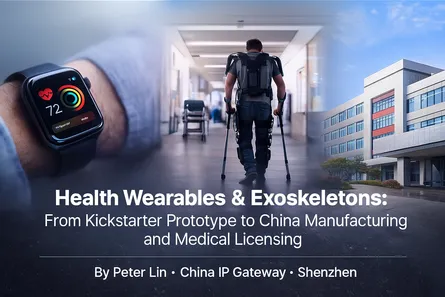
Health Wearables & Exoskeletons: From Kickstarter Prototype to China Manufacturing and Medical Licensing

What to Protect: Algorithms, Structure, and Appearance • Sensor + Gait Algorithms This is your real IP. Never over-explain the logic. Show the effect, not the “how.”• Exoskeleton / Assistive Structures Structural mechanisms (joints, linkages, load-transfer designs) are the hardest to design around. These are the best candidates for licensing later. • Industrial Design If it’s worn on the body, appearance is a selling point. Always file a design patent — it’s part of the user’s “social comfort.”Entering a Chinese Factory: Much Harder Than Kickstarter Health wearables and gait-assist devices are not regular consumer electronics. The factories are different, the requirements are different, and the risks are very real.• Small-batch prototyping is expensive Strength tests, material consistency, safety checks — the bar is high for anything that touches the human body. • Tooling ownership is a trap I’ve seen founders spend two years developing a structure, only to discover the factory considered it “joint development” and sold the same mechanism to another buyer. • ISO 13485 is not optional If you’re building anything remotely medical or assistive, the factory must have medical-grade process control. (I’ve helped overseas teams select compliant factories and helped Chinese factories pass export certification — this always becomes the bottleneck.) • Your Kickstarter prototype is not manufacturable Most health devices require DFM + second-stage engineering with the factory. This surprises every first-time founder.Commercialization: Don’t Just Sell Hardware — License the Capability The future of health hardware is not “sell devices.” It’s licenseability — especially into hospitals, rehab centers, and senior-care institutions.A. License algorithms to B2B institutions Gait analysis Posture detection Rehab training models Data dashboards Hospitals care about outcomes, not your brand size. B. License structural patents to local device makers Let local companies handle sales and regulation. You earn license fees + royalties. C. License full solutions (highest value) Hardware + software + algorithm + rehab protocol + regulatory pathway. This is where long-term revenue lives. One-Sentence Takeaway For health wearables and exoskeleton devices, the real strategy is: Protect the core → Manufacture in China → License into the medical world. Kickstarter is only your first chapter. Licensing is where the story becomes global. If you’re building a health wearable, exoskeleton, gait-assist device, or rehab product, and want help planning IP, factory entry, or licensing strategy — feel free to reach out. I’m based in Shenzhen and see these cases every week.
Kickstarter
blog-thumb
By China IP Gateway/ On 01 Dec, 2025

The Truth I Told a Chinese-American Founder About Launching on Kickstarter from China

When a hardware project goes live on Kickstarter, two things can happen: You go viral. Your copycats go viral before you. The classic case is StikBox (2015,see https://www.kickstarter.com/projects/634593202/stikbox-the-first-selfie-stick-case-for-iphone?utm_source=chatgpt.com). According to PetaPixel, only one week after the founder launched his selfie-stick phone case on Kickstarter, nearly identical copies from Chinese suppliers began appearing online — some for as low as $8, compared to the original ~$47. Article content Business Insider later reported the same trend: the design spread through the supply chain long before the original team shipped their first units. Article content This isn’t an isolated case. As someone who has spent a decade working between China manufacturing and global IP, I see this pattern every year. Kickstarter is not just a launchpad. It is a spotlight — and sometimes, a magnifying glass. And if you want to survive the exposure, you must get three things right:Protect: Secure Your Minimum Defensible Position Not perfection. Not a 300-page patent portfolio. Just the minimum protection needed to not get wiped out.Register your trademarks early (US + EU + China). China is a first-to-file country. Once someone else takes your brand name, Amazon, Alibaba, and major distributors will all block you.File 1–2 strategic patents. Most Kickstarter products need only:One core structural patent One design patent Enough to make copycats hesitate. Enough to give investors and future licensees confidence.On your Kickstarter page: show the effect, not the method. Beautiful demo video? Yes. Full technical breakdown? No.Chinese supply chains reverse-engineer from photos at astonishing speed.Manufacture: In China, “reliable” beats “cheap” by 10,000 miles Kickstarter founders often lose control not in the market, but in the factory.These are the rules I wish every founder knew: Article content NNN agreementAlways sign an NNN, not an NDA. NNN =Non-Disclosure Non-Use Non-Circumvention This is the version Chinese courts actually enforce.Don’t give full information to any single supplier. Split it:Factory A → housing Factory B → electronics Factory C → tooling Final assembly → your team or a trusted partner No one holds the full blueprint. Copying becomes much harder.Define OEM vs ODM from day one. If your agreement is vague:Your molds may be “shared” Your design may be claimed as “joint development” Your IP becomes impossible to enforce This isn’t theory — it’s weekly reality in Shenzhen and Dongguan.Commercialize: Sell Products or License IP? It Depends on Your Innovation Type Not every Kickstarter project should aim for the same “endgame.”Your best path depends on what kind of innovation you actually have. Here are the three real-world routes, refined from founder experience: Route A: Sell It Yourself (Direct Brand Sales) The best choice when: The category is not yet saturated You can control quality and supply chain Your brand story resonates You have appetite for long-term operations Article content Kickstarter gives you your first global brand exposure. Lean into it. Route B: License Core Structural Innovations (Structure-Based Licensing) This route is extremely powerful when: Article content Your exterior look is easy to copy, BUT the real innovation is inside the structure You own structural/utility patents Design-around is difficult or very costly Competing on price would destroy your margins The category is already crowded with copycats Perfect for: Robotics linkages Exoskeleton joints Motion-control assemblies Folding/slide mechanisms Mechanical sub-systems In these cases, licensing the structure often makes more money — with far better risk control — than selling hardware yourself. You earn: Upfront license fees Ongoing royalties Zero inventory pressure Zero logistics pain Route C: Brand Licensing (Brand Extensions) Choose this when: Your brand is stronger than your manufacturing capability Your Kickstarter success gave you real awareness Your brand naturally expands into related categories Regional brands want to use your name for local distribution Typical in: Outdoor gear Smart toys Lifestyle tech Niche consumer electronics Instead of scaling manufacturing yourself, you let stronger operators handle it — while you scale the brand. Article content In One Sentence Kickstarter is not just a campaign — it’s a stress test. Your long-term survival depends on how well you manage: Protection · Manufacturing · Commercialization Not just making a great product. But making a great strategy.